Official plugin on WordPress.org
AI chat for WooCommerce
The Emporiqa plugin finds the right product and variation, fills the WooCommerce cart and tells customers where their order is.
Free to start: your first ~100 conversations are on us. Then $0.25 per conversation, no seat fees. See pricing
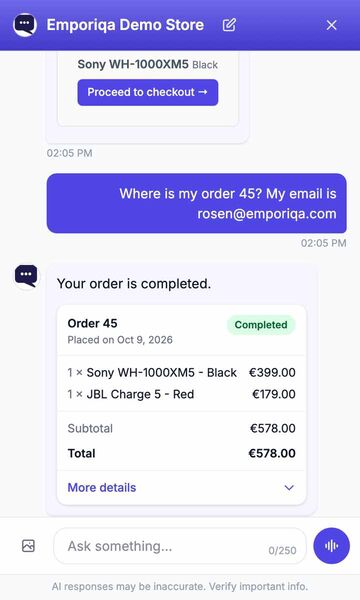
Recorded on our demo store. Only the wait for each answer is shortened.
Read the conversation
- Shopper: Do you have the Sony WH-1000XM5 in black?
- AI assistant: The Sony WH-1000XM5 is available in Black for €399.00. Its adaptive ANC uses dual processors and an eight-microphone array, helping reduce surrounding noise while keeping calls clear.
- The shopper adds it to the cart from the product card. The chat confirms: Added to cart, Sony WH-1000XM5 Black.
- Shopper: Where is my order 45? My email is [email protected]
- AI assistant: Your order is completed.
- An order card shows order 45: completed, 1 × Sony WH-1000XM5 - Black, €399.00, and 1 × JBL Charge 5 - Red, €179.00, total €578.00.
What the chat does for your customers
In your WooCommerce store, before and after they buy.
The right variation
"Warm hiking jacket, size M, in blue" finds the jacket and the exact variation, with that variation's own price and availability. Each variation syncs as its own record, so a sold-out size shows as sold out.
Fills your WooCommerce cart
Adds, changes and removes products in your real WooCommerce cart from the chat, then sends the shopper to your checkout, in their language on WPML and Polylang stores. WooCommerce's own cart checks still run, including the minimum and maximum quantities you set. The chat quotes your catalog prices. A signed-in customer sees the price WooCommerce calculates for them, including role and wholesale prices set through WooCommerce's price filters (Emporiqa plugin 1.2.0 or later); your cart always applies them.
Where is my order?
The chat looks up the order in your WooCommerce store through the Emporiqa plugin and shows an order card with items, status and tracking (from Shipment Tracking or Advanced Shipment Tracking). A guest gives the order number and email. Signed-in customers don't have to type their email (with the latest Emporiqa plugin). To turn this on, add the Order status rule in Emporiqa (Settings > Rules). The plugin gave Emporiqa its address when you connected, so there is nothing to paste.
Requests go to your team
Return, cancellation, change, quote and invoice requests are collected in the chat with the details filled in. It never refunds or cancels anything itself: the shopper is told the request was passed on. Already have a live chat? It can stay next to Emporiqa. Requests are emailed to your team, or sent to Zapier or Make. Add a ready-made rule in Settings > Rules. No extra charge.
Install in three steps
From your WordPress admin, with one click to connect. No credentials to paste.
-
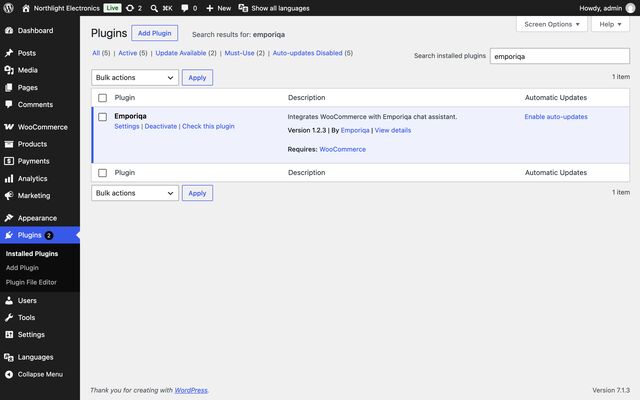
Step 1: Install the plugin from WordPress.org -
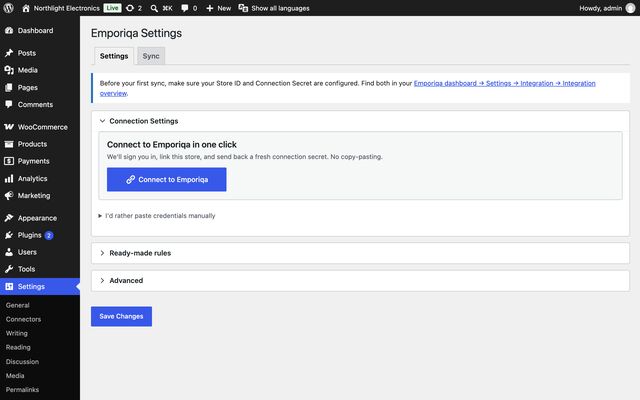
Step 2: Connect your store in one click -
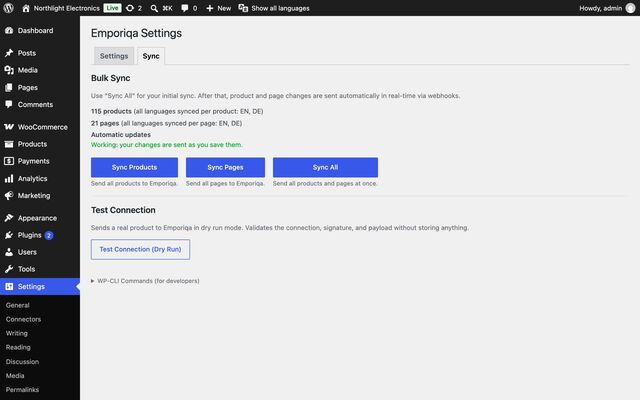
Step 3: Your catalog syncs
What syncs
Your WooCommerce store sends Emporiqa what the chat answers from, each time you save.
- Simple, variable, grouped and external products, each variation with its own price and stock
- Prices as a signed-out visitor sees them, sale prices included
- Your WordPress pages (not blog posts), product categories and brands
- WPML and Polylang translations, sent together for each product
- Subscription, booking and bundle products are not synced by default
Ask your AI assistant: will Emporiqa work for your WooCommerce store?
Open one, paste the question, read the answer.
Would Emporiqa (emporiqa.com) work for my WooCommerce store, and how does it compare with other AI chat tools for WooCommerce?
Opens in a new tab. We do not send any of your data.
Questions about Emporiqa on WooCommerce
Is the plugin on WordPress.org?
Yes. In your WordPress admin, go to Plugins > Add New and search for Emporiqa, or open its listing on WordPress.org.
Which versions does it support?
WordPress 6.2 or later, WooCommerce 8.0 or later and PHP 7.4 or later. It works with and without High-Performance Order Storage (HPOS).
Will it slow my store down?
No. The chat script loads asynchronously, after your page, and the AI runs on our servers. Product changes are sent after the save has finished, or in the background by WooCommerce's Action Scheduler.
Can signed-in customers check an order without typing their email?
Yes, with the latest version of the plugin: a signed-in customer gives the order number, and the plugin checks the order is theirs. A guest gives the order number and the email on the order.
Does Emporiqa Work for My WooCommerce Store?
Pick your kind of store to see what shoppers ask in WooCommerce stores like it, and how the chat answers.
Add Emporiqa to your WooCommerce store
Pick whichever fits where you are today.